

Trust Is the Hidden Infrastructure
The agreement before the contract

Something happened today that made me think about trust.
Not trust as a soft value printed on corporate websites. Not trust as a marketing word. Trust as the invisible infrastructure that allows people and companies to do things before every possible risk has been formally resolved.
A company I work with introduced me to another company for a specific administrative task. That introduction already carried something important. We did not begin from zero. We began from inherited trust.
They trusted me, at least partially, because someone they trusted had recommended me. I trusted them, at least partially, because that same intermediary had recommended them.
Before the contract, before the invoice, before the advance payment, there was already a small bridge.
That bridge mattered. We exchanged a few operational emails. I accepted the budget. An advance payment was agreed. The deadline for making that payment had not yet expired.
And yet, before the agreed time had passed, I received a cascade of messages asking for the payment, insisting on the responsibility they had assumed by starting the work before receiving the advance.
What struck me was not the request itself. Advance payments are normal. Risk management is normal. Protecting one’s work is normal.
What struck me was the speed with which inherited trust began to collapse.
Because the relationship was not asymmetric. They had started work before receiving the advance. But I was also about to advance most of the payment before knowing whether the work would be completed properly, on time, and with the quality required.
Both sides were exposed.
Both sides were relying on something that no email, budget, invoice, or contract could fully contain.

We were relying on trust.
Contracts do not cover reality
This is one of the great misunderstandings of formal systems.
We often behave as if contracts, laws, procedures, signatures, invoices, and payment terms were the foundation of business life. They are not irrelevant. They matter enormously. Without them, trust becomes fragile, memory becomes negotiable, and conflict becomes harder to resolve.
But they are not the whole system.
A contract can define obligations. It can describe deadlines, payments, penalties, deliverables, liabilities, and responsibilities. It can create evidence. It can provide a framework for enforcement.
But a contract cannot cover reality in full.
It cannot anticipate every delay, every ambiguity, every interpretation, every exception, every misunderstanding, every silence, every small act of good faith, every gesture of bad faith, every human anxiety that appears between one clause and the next.
The legal system is necessary because trust can fail. But the legal system also depends on trust in order to work.
We trust that invoices mean something. That signatures mean something. That commitments mean something. That professionals will behave professionally. That intermediaries will not recommend recklessly. That payments will be made. That work will be delivered. That if something goes wrong, there will be a way to repair, negotiate, document, escalate, or resolve.
Even when we know that legal systems are imperfect.
Even when we know that enforcement can be slow, expensive, unequal, or incomplete.
We still operate every day as if promises matter.
That is not naive. It is the basic condition for economic life.
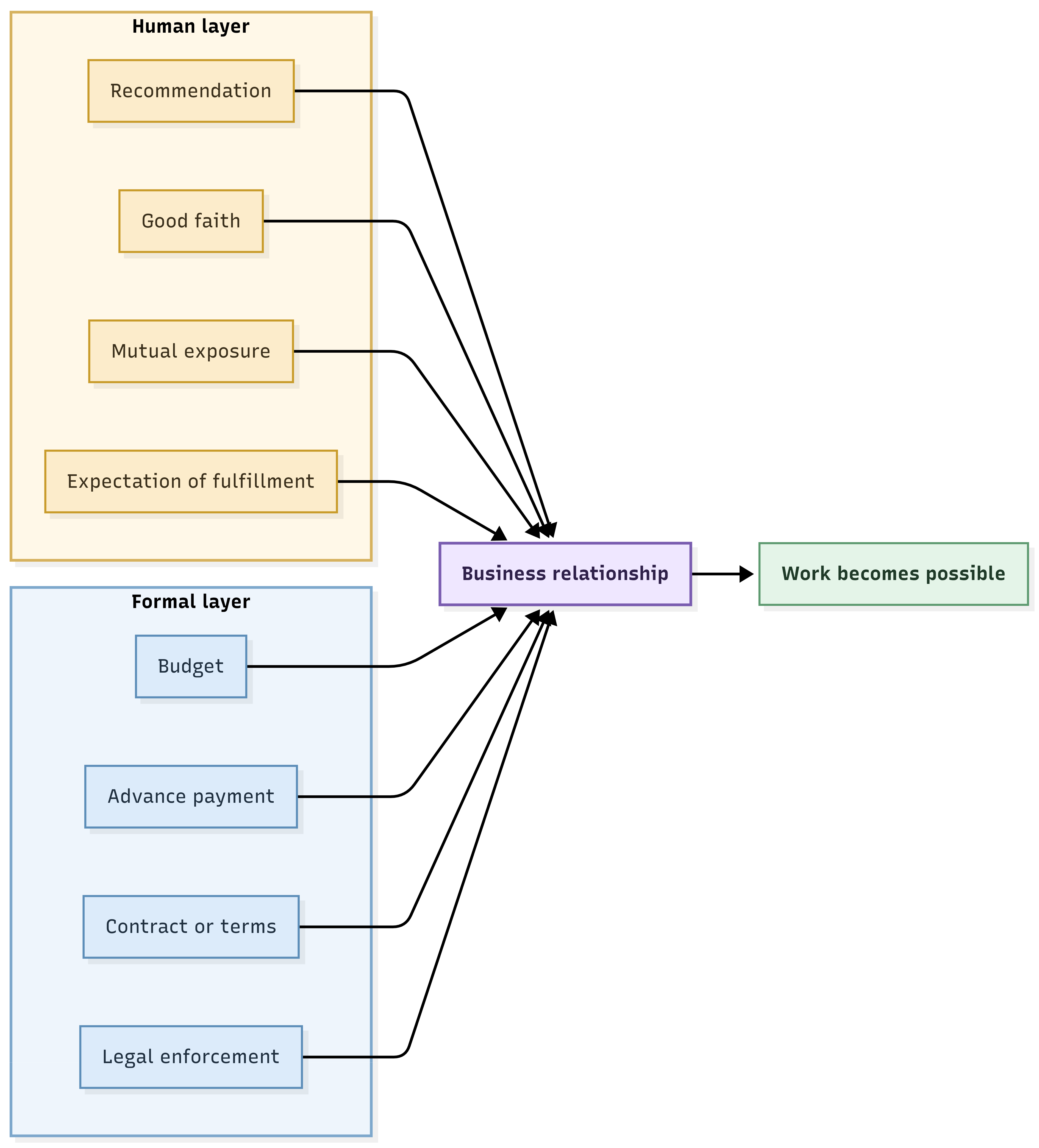
The human layer of legality
There is something deeply human inside legality.
Law often appears cold from the outside: clauses, signatures, deadlines, procedures, jurisdiction, compliance. But beneath that formal surface there is a human expectation: that people will recognize each other as responsible actors.
A payment term is not only a financial mechanism. It is also a statement of mutual exposure.
An advance payment says: I trust you enough to pay before the result is complete.
Starting work before receiving the advance says: I trust you enough to begin before the payment is complete.
A recommendation says: I am lending part of my credibility so that two other parties can begin closer than strangers.
This is why trust is not sentimentality. Trust is operational.
It reduces friction. It lowers transaction costs. It allows work to begin. It allows information to move. It allows small companies, experts, clients, suppliers, advisors, and institutions to coordinate before every uncertainty has been eliminated.
Without trust, everything becomes heavier. Every email becomes evidence. Every silence becomes suspicion. Every delay becomes threat. Every ambiguity becomes conflict.
And every relationship has to be rebuilt from zero, every time. That is not a more efficient world. It is a poorer one.
Trust needs memory
At the same time, trust cannot remain only interpersonal.
This is especially true when work moves across companies, countries, sectors, legal systems, languages, and digital environments. In small circles, trust can travel through reputation. Someone introduces you. Someone vouches for you. Someone says: I know them, they are serious.
But as networks grow, informal trust becomes harder to scale.
Who recommended whom? Under what context? What was promised? What was delivered? What was paid? What was modified? What was agreed later by email? Which version of the document was valid? Which commitment was actually accepted? Which party acted in good faith?
Modern work produces traces everywhere, but trust itself often remains fragmented.
It lives in inboxes, PDFs, payment receipts, chats, folders, memories, introductions, and implicit expectations. I still remember when only physical documents were allowed as proofs. Believe me, I experienced that time.
That fragmentation matters.
Because many disputes do not begin with fraud. They begin with uncertainty. With different versions of what each side believes happened. With a gap between formal documents and lived expectations. With the slow erosion of confidence when no shared memory exists.
This is where I think a new layer is needed. Not to replace trust. To make trust more portable, more verifiable, and less dependent on fragile private memory.
Why this matters for WeCITE
This is one of the reasons I keep thinking about WeCITE. Not only as a technology project. Not only as a way to register and manage intangible assets. Not only as a system for intellectual property, confidentiality, licensing, or traceability.
At a deeper level, WeCITE is about trust infrastructure.
It starts from a simple reality: in many valuable exchanges, what moves first is not money, and not even a finished product.
What moves first is confidence. Confidence that an idea will not be misused. Confidence that authorship will be recognized. Confidence that a document means what it says. Confidence that access, permissions, versions, commitments, and evidence will not depend entirely on scattered emails or private memory. Confidence that collaboration can begin without requiring full exposure or blind faith.
That is the hard part.
The future of digital trust will not be built only by writing longer contracts or adding more disclaimers. It will require systems that understand the human layer beneath formal exchange: reputation, evidence, permission, authorship, commitment, context, and memory.
Because trust is not the opposite of legal structure. Trust is what legal structure is trying to protect when the relationship is still alive.
The fragile bridge
Today’s episode was small, and it was not the only one today. Nothing dramatic. Just a moment of friction in a normal business process.
But small moments often reveal large structures.
They remind us that every transaction contains a fragile bridge between people who do not fully control each other. Every agreement begins before it is fully enforceable. Every company depends, more than it admits, on the assumption that the other side will behave with a minimum of good faith.
Contracts matter. Payments matter. Evidence matters. Systems matter. But none of them eliminate the need for trust.
They only make trust less fragile.
And maybe that is the point: the most important infrastructure in business is often the one we only notice when it starts to crack.
But trust does not matter only between companies. It matters even more inside them.
A company is not built only with contracts, roles, meetings, tools, roadmaps, or processes. It is built when people can rely on each other before every responsibility has been overdefined, before every risk has been formalized, before every contribution has been translated into a metric.
That kind of trust is not blind. It is not the absence of accountability. It is the condition that makes accountability possible without turning work into permanent suspicion.
I live this every day in piensas.xyz and our network of trust.
In the way people take responsibility before being asked twice. In the way ideas move faster because they do not need to be constantly defended from bad faith. In the way uncertainty becomes lighter when it is carried by more than one person. In the way a small team can do work that would be impossible if every action had to begin from doubt.
That, too, is infrastructure. Not technical infrastructure. Not legal infrastructure. Not financial infrastructure.
Human infrastructure.
And when it works, it becomes almost invisible. Things move. People respond. Problems are absorbed. Decisions are made. Work advances. Trust becomes the quiet medium through which a company thinks, acts, and becomes real.
So yes, contracts matter. Payments matter. Evidence matters. Systems matter.
But inside a company, as between companies, none of them can replace the deeper promise that makes work possible: I will do my part, you will do yours, and together we will protect the fragile space where something larger than any of us can be built.